North Dakota license plates identify every registered car, truck, motorcycle, and trailer. Each set carries a 123 ABC series, a rear sticker, and a design built around the Badlands and a bison. A first registration adds a $5 title fee and a motor vehicle excise tax on the purchase price, minus any trade-in credit. New residents have 75 days to register, and every driver renews before the sticker month ends.
North Dakota offers more than 30 designs, from the Legendary base to blackout, military, college, tribal, and organizational plates. A passenger set allows seven characters, a motorcycle six, and most specialty designs five, and mobility plates carry the wheelchair symbol. Personalized plates add $25 a year, blackout adds $25, and a personalized blackout costs $50. Custom orders take 8–10 weeks, and standard stock is issued the same day at most offices.
How to Apply for a North Dakota License Plate
A first set comes from a county counter or the state portal. The counter handles plates, registration, and title work, and the portal covers a renewal or a duplicate card. A driver should pick the errand first, since a licensing office cannot print a plate and a county clerk cannot restore a license.
- Pick the counter: a county office for plates and registration, or the state portal for a renewal.
- Build the packet: title, insurance card, photo ID, and the VIN inspection form for an out-of-state car.
- Pay the charges: excise tax, title fee, and the registration amount for the weight class.
- Choose the set: a stock plate the same day, or a custom order that waits for production.
- Finish the visit: place the sticker on the rear plate and keep the registration card in the glove box.
A newcomer gets 75 days to make the swap, and a short-term permit covers the gap as the title clears. A dealer files the title work on a new car, and a private sale puts the packet on the buyer. The plate number ties to the vehicle record, so the title and the registration must match before an office prints a set.
https://www.dot.nd.gov/motor-vehicle/license-plates
North Dakota License Plate Types
North Dakota offers more than 30 designs, and the choice comes down to the vehicle class, the message length, and the yearly fee. The summary below groups the main families, and the table matches a vehicle to a starting point for the most frequent cases.
Standard and Blackout Plates
The standard base fits a car, a pickup under 20,000 lbs, and most SUVs, with seven characters and same-day stock at an office. The blackout line adds a dark background for a yearly fee and covers passenger, motorcycle, and mobility versions.
Motorcycle, Trailer, and Mobility Plates
A motorcycle plate measures 4 by 7 inches, mounts on the rear fender, and allows six characters. A trailer plate allows seven and renews with a flat fee. Mobility plates carry the wheelchair symbol, with six characters on a car and five on a motorcycle.
Military and Veteran Plates
Branch plates, National Guard, Purple Heart, Prisoner of War, and Gold Star Family designs each carry their own proof rule. Five slots cover most designs, and a Guard plate holds four. Veterans Affairs paperwork travels with the order.
College, Tribal, and Organization Plates
College designs cover NDSU, UND, VCSU, DSU, MSU, Jamestown, and Mary with five characters. Tribal plates follow the enrolling nation’s series. Organization plates support a listed group and send part of the fee to it.
Antique and Collector Plates
An antique plate fits a vehicle 40 years or older, and a collector plate needs an affidavit of use. Both allow seven characters on a car and six on a motorcycle, and both carry a one-time personalization fee.
Commercial and Official Plates
Dealer, apportioned, fleet, and off-highway plates follow separate paperwork. ATVs and UTVs use a five-character plate, and official sets cover government vehicles with a state or county seal.
| Vehicle or goal | Start with | Max characters |
|---|---|---|
| Daily car or SUV | Standard passenger | 7 |
| Darker look | Blackout | 7 |
| Motorcycle | Motorcycle | 6 |
| Trailer | Trailer | 7 |
| Veteran | Military | 5 |
| School supporter | College | 5 |
| Older vehicle | Antique or collector | 7 |
| ATV or UTV | Off-highway | 5 |
A driver who wants a specific message should confirm the limit for the chosen design before filing. A clerk can check stock and eligibility in one call.
North Dakota License Plate Fees
North Dakota sets plate fees by vehicle weight and the year the vehicle was first registered, not by model year. Rates rise with weight and fall as a vehicle ages, and the table below lists the yearly amount for each band.
| Weight | 2021+ | 2018–2020 | 2015–2017 | 2014 or older |
|---|---|---|---|---|
| Under 3,200 lbs | $65 | $60 | $55 | $49 |
| 3,200–4,499 lbs | $81 | $75 | $68 | $61 |
| 4,500–4,999 lbs | $94 | $87 | $79 | $71 |
| 5,000–5,999 lbs | $120 | $110 | $100 | $90 |
| 6,000–6,999 lbs | $146 | $134 | $122 | $110 |
North Dakota License Plate Fees by Type
Plate type adds its own line to the total, and the amount depends on the design a driver picks. Some charges repeat each year with the registration cycle, and others apply once at the start. A specialty design may send part of its fee to a sponsoring group. The table below lists the extra charges that sit on top of registration, with the amount and the case where each one applies.
| Fee | Amount | When it applies |
|---|---|---|
| Certificate of title | $5 | One-time, new title |
| Personalized plate | $25/yr | Each registration cycle |
| Blackout plate | $25/yr | Each renewal |
| Personalized blackout | $50/yr | $25 blackout plus $25 personalization |
| Specialty / organization | $10–$25/yr | Varies by design |
| Antique personalized | $100 one-time | Antique vehicle |
| Collector personalized | $160 one-time | Collector vehicle |
| Unconventional vehicle | $50/yr | Unconventional registrations |
| Travel trailer | $20 flat | Travel trailer registration |
| Plate transfer | $5 | Moving plates to a replacement vehicle |
| EV road use fee | $120/yr | Electric vehicles |
| Plug-in hybrid fee | $50/yr | Plug-in hybrids |
Standard vs Blackout Plate
The standard Legendary plate and the blackout plate share the same numbering system, the same seven-character ceiling, and the same renewal cycle. The difference sits in the look and the yearly cost.
| Feature | Standard | Blackout |
|---|---|---|
| Background | Badlands scene with sunrise | Solid black |
| Character color | Black | White |
| Extra fee | $0 | $25/yr |
| Personalized fee | $25/yr | $50/yr total |
| Max characters | 7 | 7 |
| Formats | Passenger, motorcycle, trailer, mobility | Passenger, motorcycle, mobility |
| Delivery | Same day at an office | 8–10 weeks for custom sets |
Vanity and Personalized Plates
A personalized plate lets a driver choose the characters on the metal, and the state reviews each request before it prints. The rules cover the character field, the meanings that fail, and the search that shows whether a text is open. The sections below walk through each stage.
Rules for Personalized Characters
A personalized plate lets a driver pick the characters on the plate. North Dakota allows up to seven characters on a passenger set, six on a motorcycle, and five on most specialty designs. The state takes letters and digits, and a blank space uses one of the slots. The state charges a yearly personalization fee on top of any plate fee. A request goes to the Motor Vehicle Division on form SFN 53612, and the Plate Review Committee checks each combination for offensive or misleading readings. Reviews cover slang, reversed spellings, and meanings in other languages.
Ideas That Read Well
Vanity ideas tend to fall into a few groups: state pride (BISON, PRAIRIE, BADLNDS), sports teams, truck and farm themes, family initials, and short phrases. A crowded message reads better when the letters stand apart, so a seven-character set with a gap in the middle beats a solid run of consonants.
Checking Availability
A plate search shows whether a combination is open before the form goes in. The search tool sits in the How to Apply section above. A combination marked available can still change hands before the division processes the order, so the review committee makes the final call. Personalized plates stay with the driver across vehicle changes in most cases. The division ties the characters to the account, and a new set carries the same message for the yearly fee. A driver who sells the car keeps the right to the combination.
North Dakota Front License Plate Rule
North Dakota requires two plates on most passenger vehicles. The rule covers mounting, visibility, and the exceptions for bikes and trailers.
- Two plates: One on the front bumper and one on the rear. Only the back plate holds the decal.
- Motorcycles and trailers: A rear plate only. Motorcycles mount on the rear fender, trailers on the rear frame.
- Out-of-state visitors: Keep home-state plates and follow their own state rule.
- New residents: Swap to North Dakota plates within 75 days of establishing residency.
- Missing plate: A traffic stop and a fine, though enforcement varies by agency.
- Visibility: Covers, tinted shields, and frames that hide the state name can trigger a citation. The state name, plate number, and sticker must read clearly from a normal distance.
- Mounting: Hardware must hold the plate flat and level. A bent plate, a cracked bracket, or a plate tucked behind a grille can draw the same citation as a missing plate. Replace damaged brackets before a renewal sticker goes on.
- Dealer frames: Legal if they leave the state name and sticker clear. A frame that covers the month or year sticker fails the visibility test.
- Military and specialty plates: The same two-plate rule applies on a passenger car.
- Moved from a rear-only state: Add a front plate after the 75-day window closes.
Where Each Plate Belongs
A passenger car or pickup carries the front mount on the bumper cover and the rear bracket above the bumper. The rear plate holds the sticker, and the front plate stays blank. A truck with a flat rear bumper may need a bolt-on frame to keep the plate level, since the stock holes rarely line up with a flat surface. A winch bumper or a brush guard can hide the plate, so the mount should move to a spot that faces traffic.
Sticker and Frame Checks
The sticker month follows the plate record, so a set moved to another car keeps the original month until the next full cycle. A plastic shield that fogs with age hides the characters at night, and a chrome lip that covers the sticker corner draws the same warning. Snow and road grime count as an obstruction when a reader cannot see the number, so a wipe before a long trip saves a conversation at a stop.
Renewal, Replacement, and Transfer
Registration runs on a 12-month cycle, and the sticker shows the month and year. Renewal works online, by mail, or at a motor vehicle office. The online portal takes major credit and debit cards, and a kiosk handles renewal at some offices.
- Pull out the renewal notice or the registration card.
- Type the title and plate numbers into the state portal.
- Cover the registration and plate charges for the year.
- Print the receipt and wait for the sticker by mail.
Missed Deadlines and Early Payment
A missed deadline can add a charge, and an expired decal invites a ticket. The portal accepts payment roughly two months ahead, which keeps the office line short. Renewal notices go to the address on the registration. A move requires an address update before the notice arrives, or the sticker may go to the old address.
Kiosks and Replacement Plates
Some offices run a self-service kiosk that issues the decal on site. The machine reads the card, takes payment, and bypasses the counter queue. A lost, stolen, or damaged plate gets replaced at a motor vehicle office. Bring the registration card, the plate number, the VIN, and a photo ID. Staff print a new sticker on the spot for most standard plates. Custom and specialty sets go back into the production queue. Peeling and delamination count as damage. A plate that loses its reflective layer or sheds characters should be swapped before it draws a citation. A replacement card, sticker, or plate set carries a small office fee, and the amount depends on the part you need.
Credits and Plate Transfers
When a driver sells a vehicle, the plates stay with the seller in most cases. The remaining whole months of registration convert to a credit toward the next vehicle, and a transfer fee moves the plates over. The credit applies only to North Dakota registrations. Transfer rules differ for a leased car. The leasing company holds the title, and the driver renews through the lease agent in most cases.
Notice and Address Details
The renewal notice goes to the address on the registration, so a move needs an update before the print run. A driver who never receives the notice can pull the registration card instead, and the online portal takes the title number in place of the mailing slip. A vehicle stored for the winter keeps the same renewal date, and a lapse in coverage can block the next sticker.
License Plate Lookup
A North Dakota plate lookup ties a plate number to a vehicle record. The North Dakota license plate lookup page covers this topic in more detail. Approved NMVTIS providers return the VIN, title brands, odometer entries, salvage history, recalls, and reported accidents. The plate number and the state must match for a result to appear. A report can show the year, make, model, body style, engine, and drive type, plus prior title states, lien records, auction sales, insurance total-loss entries, and recall data from the manufacturer feed.
Reading a Report
A brand such as salvage, flood, or rebuilt should appear on both the report and the title. When the plate returns no record, the VIN from the dashboard is the better search key, and a recent transfer can take a few weeks to reach a commercial feed. A seller who cannot produce a title should end the conversation there.
Owner Privacy and Report Limits
Owner names, home addresses, and phone numbers stay private under the Driver’s Privacy Protection Act. A consumer lookup cannot reveal them. Law enforcement, insurers, and certain licensed parties can request full records through NDDOT with a permitted purpose and a completed form. Results vary by vehicle. A new plate, a recent transfer, or a replacement set may not appear in commercial databases right away. A clean report does not prove mechanical condition, and it does not replace a title check or a physical inspection. A buyer should compare the VIN on the dashboard, the door label, the title, and the insurance paper. A mismatch between the plate record and the vehicle signals a problem. Ask the seller for the full VIN and run a direct VIN check when a plate search returns nothing. A report works best as a first filter. It narrows a private sale to a short list, and a mechanic inspection confirms the rest. A title check with the state adds lien and brand data that a commercial feed may miss.
Design and Meaning
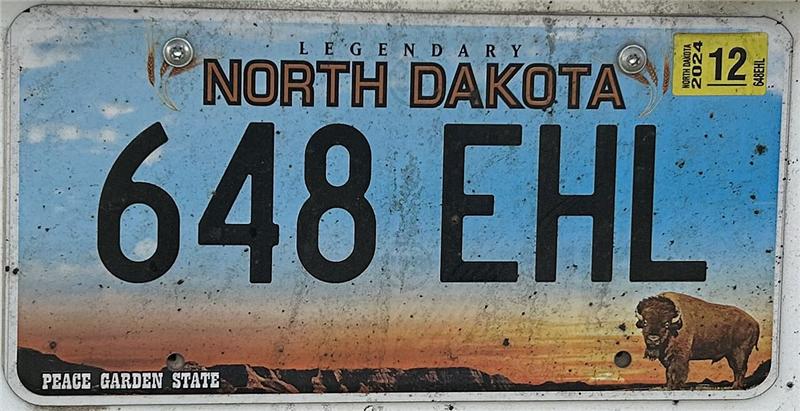
The current base arrived in 2015 and picked up a font change in 2016. It shows the Badlands at sunrise, a bison, and three wheat stalks. “Legendary” sits above the state name, and “Peace Garden State” runs along the bottom left.
From Embossed Steel to Flat Print
Earlier bases carried different slogans. The 1993–2015 base used the “Spirit” slogan, and the 1989 Centennial plate marked the state’s 100th year. Collector plates from each period still trade online. The plate measures 12 by 6 inches and uses reflective aluminum. Flat printing replaced embossed characters in 2015, which changed the look of every number and letter. A renewal sticker sits on the rear plate, and the front plate carries no sticker. The 2015 redesign kept the same 123 ABC pattern but moved the serial to the top center. Flat printing gave the characters a cleaner edge, and the bison moved to the lower right. The wheat stalks stayed beside the state name. Earlier bases used embossed steel with raised characters. Collectors sort those plates by year, and a matched pair from the 1950s can sell for more than a single plate.
Each element carries a meaning:
- The bison: honors the state’s wildlife heritage.
- The wheat stalks: point to the agricultural base.
- The sunrise and canyon colors: pull from the Little Missouri Badlands.
- The 123 ABC format: moved letters to the suffix position for the first time since 1980.
Frequently Asked Questions
These are the questions drivers ask most often at North Dakota motor vehicle offices. Each answer reflects the 2026 fee schedule and the current NDDOT rules. For a specific vehicle, the fee calculator in the How to Apply section gives an exact total.
How much does a North Dakota license plate cost?
A standard passenger set costs nothing beyond registration, and the yearly amount depends on vehicle weight and the year first registered. Personalized, blackout, and specialty designs add their own yearly line. A first title adds a title fee and an excise tax on the purchase price. The fee tables above list every amount.
Do you need a front license plate in North Dakota?
Yes. A car or SUV normally shows a plate on both bumpers. A bike or a trailer uses a single plate on the back. A visitor keeps the home-state rule, and a new resident has 75 days to make the swap.
How many characters can a personalized plate have?
Seven on a passenger set, six on a motorcycle, and five on most specialty designs. Letters A–Z and numbers 0–9 are allowed. Spaces count toward the limit, and the Plate Review Committee can reject a combination that reads as offensive or misleading.
How long does a custom plate take?
A custom or specialty order needs roughly two months in production. Standard and blackout passenger plates sit in stock at most offices, so a driver can leave with a set the same day. Mobility-impaired and custom blackout sets follow the longer timeline. A request that needs eligibility papers can add a week before production starts.
Can you look up the owner of a North Dakota plate?
No. Federal privacy law blocks owner names and addresses from consumer lookups. A plate search returns vehicle data such as the VIN, title brands, and recalls. Law enforcement and licensed parties can request full records through NDDOT for a permitted purpose. A VIN check fills the gap when a plate search returns no match.