

North Dakota calls the product a personalized license plate, and the name points at the one part a driver controls: the character field. The rest of the metal is fixed artwork, from the bison on the standard set to the seal on a college design. A personalized plate prints a chosen string in that field, and form SFN 53612 carries three ranked choices through review before the stamping run.
This page covers the field itself: how many slots each plate family gives, which letters and numerals fit, how a design renders in a preview, what the state charges, and how long the stamped set takes to reach a mailbox. Every figure here reflects the current North Dakota process and fee sheet, from the $25 standard line to the $50 blackout line and the 8-to-10-week mail window.
How to Get a North Dakota Personalized License Plate
The path to a personalized set runs through one state form and one local office. The North Dakota License Plate page covers this topic in more detail. A driver picks a string, checks it against the state list, writes three ranked choices on the paper, and pays the yearly charge with the registration. The stages below follow that order, and each one closes a gap that a clerk would otherwise flag. Form SFN 53612 is the application for a personalized plate, and it fits on one sheet. Bring the title or registration card, a photo ID in the owner’s name, and the plate charge. A driver who files by mail sends a copy of the ID and a check, and keeps the original papers at home.
- Draft two or three strings in a preview tool and save the render that reads best at a distance.
- Run each string through the state plate search for the family you plan to order.
- Print SFN 53612 and write the owner name, address, vehicle data, and current plate number.
- Rank three choices in capital letters, each counted against the field for that family.
- Sign and date the page, with both owners signing when two names sit on the title.
- Pay the yearly personalization line with any registration balance at the counter or by mail.
- File the receipt and the dated search printouts in one folder until the metal arrives.
A clerk compares the form to the title record before the request moves on. An identification number typed wrong, an address that no longer matches, or a missing signature holds the packet at the counter. A string can leave the pool during the days a fix takes, so a driver should correct errors the same week they surface. A mailed packet deserves a method with tracking, and the tracking number belongs beside the copy. A receipt that lists the three ranked strings settles a question later if a different text arrives in the envelope. The plate charge rides with the yearly registration cycle, so a mid-cycle request carries both lines at once.
https://www.dot.nd.gov/forms/sfn53612.pdf
What Counts as a Personalized Plate
The personalized part of the plate is the field, and nothing else. State name, slogan band, background art, and the small month and year stickers all follow the design a driver picked. A request that alters the artwork is a different product. A request that alters only the characters is a personalized plate. A string of capitals and numerals in that field counts, and so does a name, a short word, a set of initials, or a business name. A blank field does not count, and neither does a copy of the series already assigned to the vehicle. A dash, a heart, or a lowercase letter is not something the field accepts. Two owners can share one personalized plate when both names sit on the title. A company vehicle can carry a business name, yet the form needs the signature of an authorized agent. A driver who wants the same string on a second car files a second request, since each plate record stands alone.
What the Field Replaces
Every plate leaves the factory with a series the state assigns, usually a mix of three letters and three digits. Personalization swaps that series for the string on the form and leaves the rest of the layout untouched. The assigned series comes back only when the driver drops the personalization at renewal. Some drivers ask for a frame or a symbol set inside the field, and the request fails at the counter rather than in review. The plate family fixes the type, the border, and the spacing of the string. A driver who wants a custom border is shopping for a novelty plate, not a state-issued one.
Character Rules and Character Limits
The field width comes from the plate family, and the family is printed on the form beside the type box. The vanity plates page covers this topic in more detail. Count every slot, including a space. A seven-character idea loses a letter the moment a gap joins it, and a clerk cannot widen the field for one driver. The table below lists the typical families.
| Plate family | Slots in the field | Notes for the driver |
|---|---|---|
| Passenger car or truck | 7 | Widest field; the usual personalization choice |
| Motorcycle | 6 | Smaller metal, rear mount, one plate issued |
| Trailer | 7 | Full-width layout, same count as a passenger set |
| Blackout design | 7 | Same field, higher yearly line |
| College or university | 5 | Seal and team colors claim the edges |
| Military or veteran | 5 | Branch art plus an eligibility check |
| Tribal nation | 5 | Nation seal, short field |
| Antique or collector | 5 | Heritage layout, one-time charge |
Spaces, Symbols, and Slim Letters
A space works as a character and takes one slot. Symbols never appear on a North Dakota plate, so a dash or an ampersand ends the idea before the form is signed. Lowercase letters are not used; the field prints capitals only, and the state reads every request that way. Thin letters such as I sit beside the numeral 1 without much separation, and O next to 0 reads as one shape at highway speed. A driver who wants a legible plate should mix wide letters with one or two numerals and leave a slot free when the idea allows it. A text made of numerals alone can pass for a series the state already issues, which invites a second look at the counter. A short word with a single digit tends to read faster from twenty feet away, and that distance is the one that matters for a plate on the road.
Design Choices for Colors, Symbols, and Layout
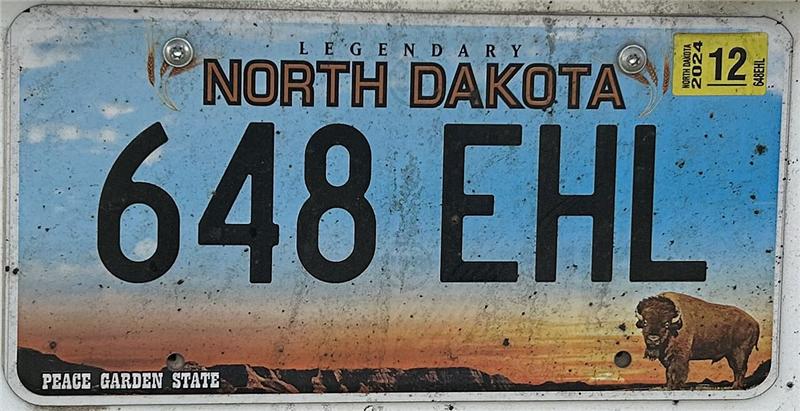
The standard design sets dark blue characters on a pale field, with a bison in the middle and the state name across the top. That contrast carries seven slots well. A preview should draw the same frame, so the driver can see where the artwork crowds the field and where the string sits. The blackout design reverses the balance: white characters on a black field, a thin border, and no bison. It reads sharply on a dark truck and shows road film sooner than a pale set. A personalized blackout keeps the seven-slot field of the standard plate and adds a higher yearly line.
- Standard: pale field, bison art, Legendary band, seven slots, lowest yearly charge.
- Blackout: black field, white capitals, seven slots, higher yearly charge.
- College and university: team colors and a seal, five slots, school support line.
- Military and veteran: branch emblem, five slots, eligibility proof required.
- Tribal: nation seal, five slots, tribal letter required.
- Antique and collector: heritage colors, five slots, billed once.
Layout matters as much as color for a short string. A three-letter text sits best with wide tracking and a centered position, and a full seven-character line needs tighter spacing to stay inside the frame. Compare both extremes in the same design before settling on one.
Reading a Design at a Distance
A plate is read from thirty feet in traffic, not from a foot away at a desk. Light characters on a light field look crisp on a monitor and fade into the bumper in sun. A dark string on a dark design holds up better at night and worse in rain, so test the render on both backgrounds. A preview that offers a slider for background shade lets a driver compare a light and a dark field on the same string. Keep the chosen shade, the slot count, and the design name in one note, so the form matches the image. A plate ordered from memory tends to come back wrong. Contrast decides whether a message reads at fifty feet. Dark characters on a light field catch the eye first, and a light string on a dark base needs thicker strokes. A busy background behind the characters costs legibility, so a scenic plate rewards a short string. A driver should stand ten feet from the screen and read the draft out loud before approving the art.
Preview the Plate Before You Order
A preview tool paints the layout in the browser and takes about a second per render. The license plate ideas page covers this topic in more detail. The driver types a string, picks a design, and reads the result at the proportions of the metal. No file leaves the device, and no state record changes from the drawing. The useful test is distance. Shrink the render to four inches wide, hold it at arm’s length, then move back across a room. A string that blurs at that range will blur on the road, and a color pair that merges on the screen will merge on aluminum.
What the Preview Gets Right
The frame, the artwork position, the slogan band, and the slot count all come from the design template. A well-built tool locks the field to the family, so a five-slot specialty layout refuses a seventh keystroke instead of letting the text spill past the border.
What the Preview Cannot Tell You
The drawing cannot say whether a string is free, and it cannot predict a rejection. Paint shade on stamped aluminum differs from any screen, and the sample plate on the office wall is the better color reference. Treat an exported image as a sketch to show a clerk, not as proof of anything. Save each draft under the string itself, so three files stay sorted and a clerk can read the exact text without asking twice. A phone photo of the monitor works in a pinch, yet a saved image at full size reads cleaner at the counter.
What a Personalized Plate Costs
The personalization line is billed with registration and returns each year on a standard set. Antique and collector plates take a single charge instead. Registration follows weight and the year of first title, and both lines appear together on the renewal notice.
| Item | Amount | Cycle |
|---|---|---|
| Personalized plate, standard | $25 | Yearly |
| Personalized blackout | $50 | Yearly |
| Blackout plate, assigned series | $25 | Yearly |
| Specialty or organization plate | $10–$25 | Yearly |
| Antique personalized | $100 | One-time |
| Collector personalized | $160 | One-time |
| Plate transfer | $5 | Once |
| Registration, passenger car | from $65 | Yearly |
A driver who drops the string at renewal stops paying the personalization line and receives an assigned series. Moving a plate to another vehicle takes a transfer fee, and unused whole months of registration carry over as credit on the new record. A driver should ask for an itemized receipt that separates the personalization line from registration. The split matters at tax time for a business vehicle and at renewal when a clerk compares the two totals. Keep the receipt with the copy of the plate form.
Splitting the Charge Across a Cycle
An order filed in the last week of a registration cycle can split the personalization line across two billing periods. That split confuses the sticker date more than it confuses the total. File after the renewal posts, and the two charges land on one notice with one due date.
Checking Availability
The state plate search reads the issued list for one family at a time. Type the string in capitals, choose the family, and read the result row by row. A clear result reflects that minute only, and it places no hold on the text.
- Open the state plate search and pick the family you plan to order.
- Type the string exactly as it would print, spaces included.
- Write the date and the result beside each of the three choices.
- Repeat the search on the morning the form goes out.
Close Matches and Pending Paper
The search may list near matches beside the exact string, and those rows point to a later refusal. A request waiting in the queue does not appear in the public list, so a clear result can still lose to a form filed last week. Check every ranked choice, not just the first. A record can leave the list when a driver surrenders a plate, which frees a string that looked taken in spring. Two drivers who want the same text in the same week should expect the earlier postmark to win. File within a day or two of a clear result, and the window stays short. A search that returns no match does not reserve the string. Another driver can file the same request an hour later, and the office processes requests in the order they arrive. A driver who needs the plate for a gift should file early and keep a second and third choice ready. A clerk can read the current queue and say whether a message is likely to clear before a birthday or a trip. The search page updates as records change, so a check from last month is not proof of anything. A fresh check on the day of the order is the only one that counts.
From Order to Mailbox
A personalized set is stamped in a separate run, and the mail brings it in about eight to ten weeks. No counter can print one on the spot. The current plates stay on the vehicle through the wait, with the registration sticker on the rear plate. A passenger vehicle receives two plates in the envelope, and a motorcycle receives one. The wait begins when the review clears, so a slow review pushes the whole timeline. A trailer order follows the passenger path and arrives as a pair.
Address Changes and Sold Vehicles
The set goes to the address on the registration, not to a note scribbled on the form. A move during the wait needs an address update at the office, or the envelope lands at the old home. A vehicle sold before the set arrives needs a call about routing the plate to the next record. A driver who leaves North Dakota should close the registration and surrender the old plates rather than wait for metal that no longer fits the record. A driver who buys a replacement car during the wait should finish the title work first, since the plate record follows the title.
When the Mail Runs Late
Ten weeks with no envelope justifies a call to the office that took the order. Have the receipt, the filing date, and the three ranked strings ready. Spring renewals and December holidays slow the run, and a show or a wedding date deserves an extra month of margin. The order moves through three hands: the counter clerk, the state print shop, and the mail room. A request that clears review on a Monday can reach the press by the same week. The state mails the set to the address on the registration, and a move during production needs an address update at the office. A driver should keep the receipt until the metal arrives, since it carries the order number and the date.
Frequently Asked Questions
These five questions cover the details drivers ask about the personalized field, the charge, and the wait for the mail.
Is a personalized plate different from a specialty plate?
A personalized plate carries a chosen string in the normal field and keeps the artwork of its family. A specialty plate carries a cause, school, or service design. Many specialty layouts accept a personalized string in a shorter field of five slots, which puts both products on one piece of metal.
Can a personalized plate carry a business name?
Yes, a business name fits when it matches the field width and passes review. A company vehicle needs the business name on the registration and the signature of an authorized agent. A logo or a graphic mark cannot go on a passenger plate, since the state prints characters only.
Does the personalization charge stay the same at renewal?
The line returns each year at the same rate for that design, and the total follows the registration class of the vehicle. A standard set carries the lower line and a blackout carries the higher one. Antique and collector personalization is billed once and does not repeat.
Can I move a personalized plate to another vehicle?
Yes, with a transfer fee and matching plate family. The string stays with the plate when the family does not change, and unused whole months of registration become credit on the new record. A change from a passenger set to a motorcycle or a specialty design starts a new request with a new field width.
How early should I order before a deadline?
Allow twelve weeks for a date that cannot move, such as a show, a wedding, or a trip. The standard estimate is eight to ten weeks from a cleared review, and spring and December add days. File the form the week the string clears the search, and the margin stays comfortable.